
For this month’s recipe, I’ve decided to show how we do our Parsnip dish, since we’re probably gonna have to change it as soon as its season comes to an end by the end of the month. These are a series of recipes that can be very easily done at home and separate from each other if so desired. The Roast Parsnip could be served as garnish for a meat roast, the Velouté could be served as a delicious soup, the Chestnut Escabeche is great served with a nice jamón platter, for example… However, our Vegetable Stock recipe is something I’m quite proud of. Developed during the darkest hours of the Pandemic, it’s a very elegant, clean building block for a series of things we do at the restaurant.
This is a dish that’s complex but very easy to understand. Its comfortable nature resonates well with our customers, especially when we present it halfway through our menu. It’s hearty but yet light, and the smell of roast parsnip has this reminiscent aroma of curry, which, to me, immediately means comfort.
Parsnips have been cultivated in Spain for a long time. Before the arrival of the potato in the 16th century, it was one of the key European root vegetables. More present in northern Spain, it was treated pretty much as it is today: boiled, mashed, roasted, added to soups. Its strong aroma and sugar content were really appreciated in rural areas, where people used it as a natural sweetener before the access to refined sugar became a commodity.
However, with the arrival of the potato, the Parsnip became a secondary crop, due to it being a more complicated crop to grow in scale and not as productive as the potato. In many areas, they became a crop for the animals, due to its high energy content.
Today, it has become an almost forgotten crop in Spain. I like that we pay homage to such an old vegetable variety and bring back a vegetable that once was present in a lot of tables.
For the Chestnut Escabeche
· 300g Oil, olive
· 290g Shallots, peeled and sliced
· 40g Garlic, peeled and sliced
· 40g Pepper, black, whole
· 375g Vinegar, apple cider
· 375g Vinegar, Sherry
· 100g Honey
· 1000g Chestnuts, cooked and peeled
Gently poach the Shallots and Garlic in the Olive Oil in a pot big enough to hold all of the ingredients over medium-low heat.
Meanwhile, toast the Black Pepper in a dry frying pan until fragrant but not burnt. When the Pepper is nicely toasted, add it to the Olive Oil, Shallots and Garlic.
When the Shallots, Garlic and Black Pepper are cooked through and soft, add the Vinegars and Honey, whisk well and bring it to a simmer.
Meanwhile, place the Chestnuts in a plastic container big enough to hold all of the ingredients.
Strain the boiling liquid over the Chestnuts, pressing well on the solids to remove as much liquid as possible. Discard the solids.
Immediately cover the container and let it come to room temperature. Wait for at least 3 days to start using the Chestnuts.
For the Flor Vegetable Stock
· 700g Carrots, peeled and quartered
· 400g Onions, peeled and quartered
· 220g Shallots, peeled and left whole
· 560g Leeks, white parts only, cut in half lengthwise
· 40g Garlic, peeled and left whole
· 200g Fennel, bulb, cut in half
· 6g Anise, star
· 40g Sugar
· 1000g Cider, Basque
· 8000g Water, filtered
· 12g Parsley, sprigs
· 6g Thyme, sprigs
Put all the ingredients except for the Parsley and Thyme in a tall and narrow stockpot. Place a thermometer touching the liquid, close it with its lid and put it on the stove over high heat.
When the thermometer reaches 92ºC, lower the heat to keep a steady but gentle simmer. Remove the thermometer and cook the Stock for 30’.
Remove from the heat, add the Parsley and Thyme and let it infuse at room temperature for 4H.
Strain through a chinois and vacuum seal weighting 2kg for each bag.
For the Cured Egg Yolk:
· 24ud Egg, yolks
· Xg Oil, sunflower
· 100g Soy, sauce, light
· 100g Mirin
· 100g Sake, dry
· 11g Sugar
Place the Yolks in a heatproof container and completely cover them with Sunflower Oil. Cook in a steam oven or sous vide set at 75ºC for 30’. The yolks should come out completely cooked through. Alternatively, poach room temperature whole eggs in a pot of simmering water for 10’, transfer to an ice bath until completely cooled down, peel the Eggs, keep the whites for another use and use the Yolks.
Meanwhile, gently warm the remaining ingredients until the Sugar is dissolved in the liquid.
With a hand blender, blend the Yolks and add enough liquid to acquire a purée consistency.
Transfer to piping bags and keep it in the fridge.
For the Parsnip Velouté:
· 575g Parsnip, peeled and sliced
· 1150g Flor Vegetable Stock
· 200g Butter, cubed and cold
· Salt, fine
Vacuum seal the Parsnip and Vegetable Stock and cook it in a steam oven set at 100ºC for 1 hour, until super tender and almost breaking apart. Open the bag and strain through a sieve. Keep both the Parsnip and the Stock. Alternatively, cook the Parsnip in the Flor Vegetable Stock until super tender over medium-low heat in a pot with the lid on.
Set a Thermomix to 100ºC for 10’, add the Parsnip and start blending on low. Little by little add enough Vegetable Stock and increase the speed gradually to 10 to achieve a purée consistency. It should be 100% smooth.
Blend it again at medium speed and, piece by piece, add the butter.
Alternatively, go through the same process using a normal blender.
Check the consistency. If it’s too thick, add enough vegetable stock to achieve a perfect velouté. A good tip is to mix the Velouté with a spoon and see how the Velouté falls from the spoon. If it leaves a trace on the surface of the velouté when it falls from the spoon, it needs more Vegetable Stock. Season with Salt.
For the Roast Parsnip:
· Xud Parsnip, 15cm in length, with a nice and interesting shape, whole
· Xud Garlic, cloves, smashed
· Xud Lemon, cut into wedges
· Xg Salt, fine
· Xg Butter, cubed
Set the oven to 180ºC.
In a GN or tray, arrange the ingredients snuggly.
Roast the Parsnips for about 35’, rotating it every 10’ so it cooks evenly and squeeze the Lemon Wedges halfway through cooking to release their juices. The Parsnips are done when they’re completely cooked through and soft.
Remove from the oven and keep at room temperature.
For the Parsnip Glaze:
· 1 part Parsnip, juice, strained (passed through a juicer)
· 1 part Whey, leftover from making fresh Ricotta
· 0,5 part Vinegar, apple cider
· 0,5 part Lemon, juice, strained
Reduce all of the ingredients over high heat until it reaches a coating consistency. Keep at room temperature.
Alternatively, replace the Whey for Vegetable Stock.
To finish the Dish:
· Roast Parsnip, 1 per person
· Maldon salt and Pepper
· Parsnip Velouté, 3 tbsp per person
· Chestnut Escabeche, coarsely chopped
· Cured Egg Yolk
· Watercress, leaves, with 2cm of its stems still attached
· Lemon, juice, strained, in a spray bottle
Warm the Roast Parsnip in the oven.
Meanwhile, warm the Parsnip Velouté in a pot.
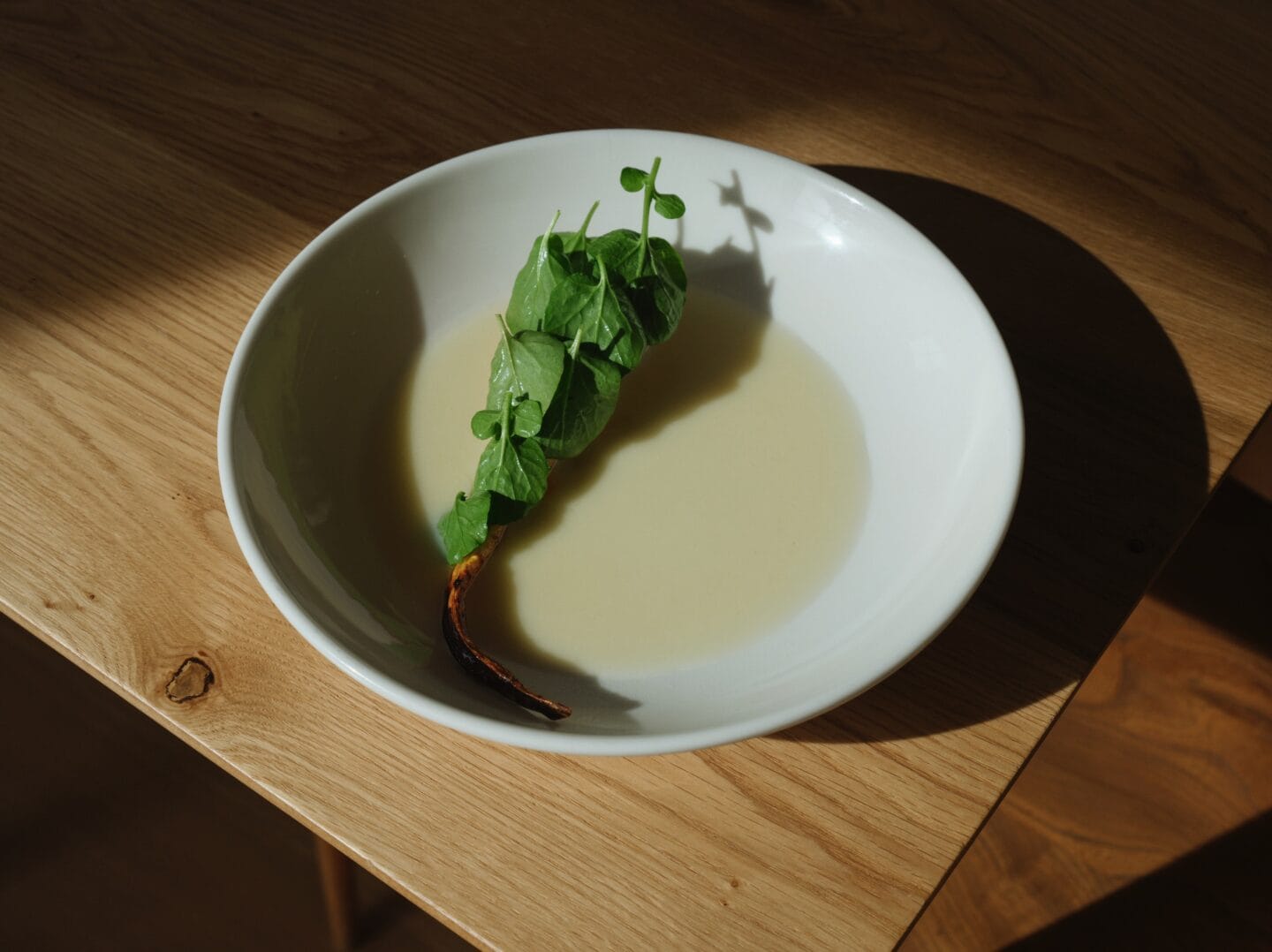
Make an incision with a pairing knife in the Parsnip and open it slightly with the back of a spoon. Season the inside with Maldon Salt and ground Black Pepper. Fill it with the Chopped Chestnut Escabeche and apply the Cured Egg Yolk over the whole Parsnip with a zigzag motion.
Place the Watercress Leaves over the Parsnip, arranging them facing-down and uniformly.
Spoon the sauce over a bowl and place the Parsnip on top. Spray 3 times with the Lemon Juice and serve immediately.